VinylPlus®the European PVC industry's voluntary commitment to sustainable development, recycled 739,525 tonnes of PVC last year - an increase of 15.6% compared to the previous year. The results were presented at the VinylPlus Sustainability Forum 2019 in Prague, where the industry presented its latest achievements in increasing the sustainability of PVC.
The event on 9 and 10 May 2019 was held under the motto "Driving innovation forward" and dealt with the challenges and opportunities that new technologies offer in shaping the future of the PVC industry for a circular economy.
The forum was attended by more than 170 participants from 32 countries, including representatives from the European Commission, the European Parliament, the Czech Ministry of the Environment, the United Nations, non-governmental organisations, universities as well as professionals, designers, recyclers and the PVC value chain. Presentations and panel discussions by high-calibre experts focused on the three pillars of sustainability - economic, social and environmental - and how innovation is impacting the PVC industry and its journey towards sustainable development.
Almost five million tonnes of PVC recycled since 2000
Brigitte Dero, Managing Director of VinylPlus, announced that the PVC industry achieved a new record in 2018 with a recycling volume of almost 740,000 tonnes despite regulatory hurdles. This is already 92.4 percent of the 2020 target, with Recovinyl still contributing the majority of recycled PVC at 734,568 tonnes. Cumulatively, almost five million tonnes of PVC have been recycled since 2000. "VinylPlus continues to be a pioneer for the circular economy," says Brigitte Dero. "With our voluntary commitment, we are making continuous progress in achieving our sustainability goals in the face of changing EU directives for the plastics industry."
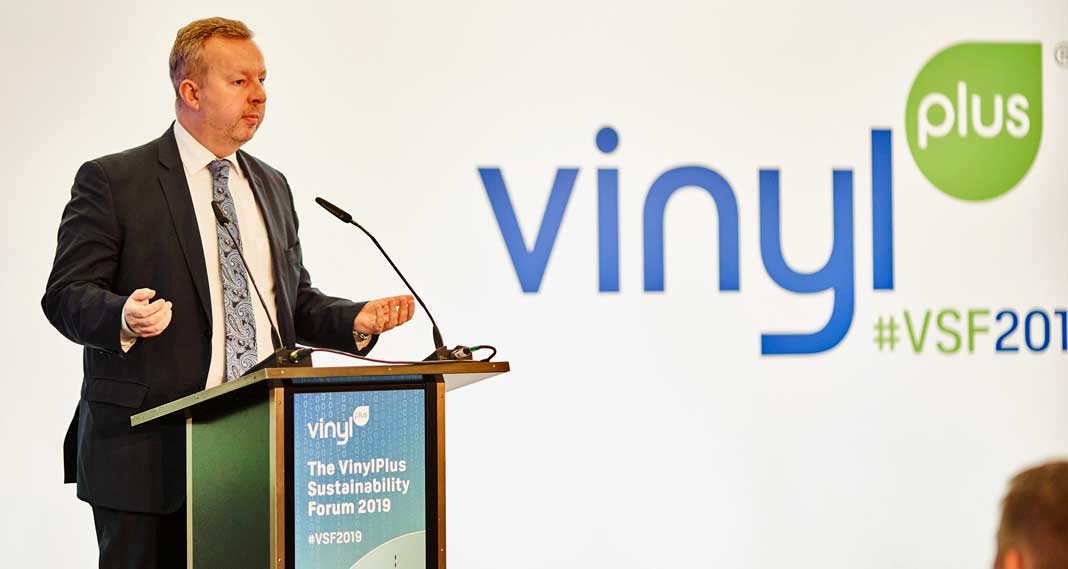
The Sustainability Forum was opened by Czech Environment Minister Richard Brabec, who emphasised the need for the sustainable use of plastics in a circular economy. He called for both recycling and the demand for recycled products to be further increased and utilised.
Strengthen co-operation with partners
Welcoming the participants, Stefan Sommer, Chairman of VinylPlus, said: "The reason for the success of VinylPlus is the commitment of the entire value chain, with PVC producers and additive manufacturers as well as PVC converters working together. To achieve further success, we need to strengthen co-operation with our partners and possibly identify new ones." He went on to emphasise that "a balanced and harmonised legal framework for plastics recycling is essential to secure our contribution to the circular economy and achieve our new recycling target of at least 900,000 tonnes per year by 2025." This would also be in line with the European Commission's target of 10 million tonnes from the plastics industry and underline VinylPlus' ongoing commitment to regulators and institutions.
Martina Dlabajová, Member of the European Parliament, spoke about the role of the industry in the development of society and educational needs. "It is time to talk about accelerating innovation to adequately address the challenges and opportunities of the future. Climate change, sustainability and the environment are important issues that set the political agenda," said Dlabajová. She added: "The shift towards sustainable development requires a change in thinking. I often use VinylPlus as an example of a voluntary industry commitment that really works. Only by working together with business and industry can politicians make informed decisions."
Fulvia Raffaelli, Head of Unit at DG GROW of the European Commission, then emphasised the adaptation of the construction sector to the digital age. "Construction is often perceived as a conservative industry, but this is not true. It is very innovative and digitalisation can really help to drive innovation towards sustainability. This is where we need to combine our efforts: to drive digitalisation in this industry to achieve sustainability goals across the entire life cycle - from the design phase to use and recycling at the end of the life cycle."
Ilcheong Yi, Senior Research Coordinator of the United Nations Research Institute for Social Development (UNRISD), outlined the impact indicators for sustainable development for social and economic activities as well as for profit-oriented companies and explained: "The combination of the social, economic and environmental pillars is crucial. Sustainable development is more than durability. VinylPlus is a good example of a holistic approach to these fundamental values. "
Jenny Walther-Thoss, Policy Officer of Sustainable Biomass and Sustainable Certification at WWF (World Wide Fund), spoke about environmental standards and certifications from the perspective of an NGO. She emphasised that products must fit into a more holistic approach to the circular economy through more efficient production methods and a focus on the longevity of a product. When discussing certification schemes, she emphasised the need to achieve impact and value, but recognised that it is difficult to find this balance.
VinylPlus Product Label for four more window profile manufacturers
Four more profile manufacturers - Deceuninck, Finstral, Salamander Industrie Produkte and Internorm - were honoured with the VinylPlus Product Label at a ceremony. This means that eight window profile manufacturers now carry the product label for a total of 43 systems, which are manufactured at 13 European locations in 11 countries. The VinylPlus product label is based on sustainability criteria and is open to all PVC construction products, including responsible sourcing and the responsible use of additives.
Dr Jo Dewulf, Professor of Bioscience Engineering at the University of Ghent (Belgium) and new Chairman of the VinylPlus Monitoring Committee, gave a keynote speech on sustainability as a key driver for innovation in the plastics industry and spoke about the impact of innovation on the future of the PVC industry.
Arab Hoballah, team leader of the EU-SWITCH-Asia Sustainable Consumption and Production Facility (SCP) and former head of the SCP of the United Nations Environment Programme (UNEP), concluded the forum by emphasising how "eco-innovation" could help to overcome the sustainability challenges facing the PVC industry. "This requires the end-to-end consideration of sustainability according to the life cycle approach in all business processes and the development of new types of solutions to fulfil market requirements. We can't live without plastics today, so let's talk about the 'good guys' properly."
Commenting on the forum, Brigitte Dero said: "VinylPlus has been leading the way towards a circular economy for almost 20 years by improving the sustainability performance of PVC. We will continue to build on our voluntary commitment to the industry through ever closer collaborations and partnerships with our sustainability goals in mind."
Further information on the results of VinylPlus in 2018 can be found in the 2019 progress report: https://www.vinylplus.eu