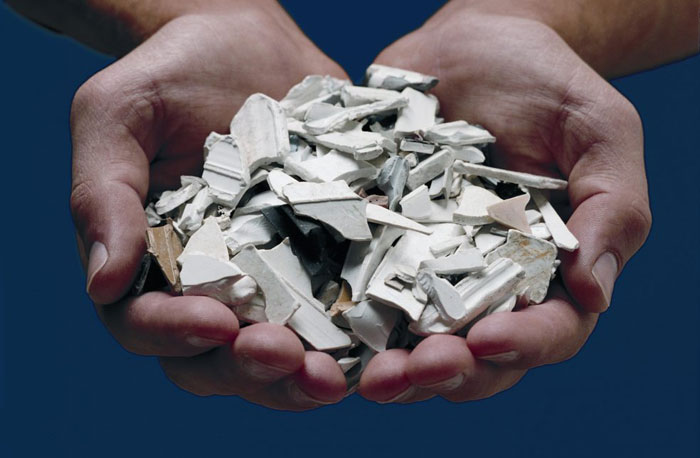
Used PVC products are far too good to throw away. In order to conserve valuable resources, the PVC industry has therefore organised the recycling of the most important PVC products and is also setting itself ambitious goals for the future in this area.
Industry uses significantly more recyclates
Despite the adverse economic conditions, the German PVC industry has made further significant progress towards a functioning circular economy. This is shown by the current material flow diagram for PVC in Germany 2021, jointly commissioned by VinylPlus Deutschland and PlasticsEurope Deutschland. According to this, 340,000 tonnes of PVC recyclates plus 1.57 million tonnes of virgin PVC were processed into semi-finished and finished products in Germany. This means that the use of recycled PVC increased by a total of 91,000 tonnes compared to 2017. This is a very significant growth of almost 37 per cent compared to 2017. Despite a decline in the use of virgin PVC, the total PVC processing volume of 1.91 million tonnes was thus also 3.8 per cent higher than in 2017. "Almost 18 per cent of the PVC processed in Germany is now obtained from recycling. Recyclates are already an important raw material base for us, which we use to reduce the use of fossil raw materials. In the transition to a CO2-neutral economy by 2050, closed material cycles will be of great importance. We are on the right track here," says VinylPlus Germany Managing Director Thomas Hülsmann.
The recycled materials produced through mechanical recycling are used primarily in building products such as windows or other building profiles, pipes or traffic safety applications. Long-life applications, in other words, which have already made up the dominant share in processing for a long time. In 2021, the construction sector was again the largest application area, accounting for more than 75 percent of the total processed PVC of 1.91 million tonnes.
Compared to 2017, the volume of PVC waste increased by almost 24 percent to 861,000 tonnes in 2021. This increase is determined in particular by the increasing return of durable building products, which have been increasingly installed since the 1970s and 1980s. The amount recycled also increased significantly in the same period: 854,000 tonnes of PVC were recycled in 2021, almost 170,000 more than in 2017. Broken down by recycling method, the amount breaks down as follows: 42 percent of the PVC waste was recycled materially and 57 percent under energy recovery, for a total of 99 percent.
The export of waste plays virtually no role in the case of PVC. Only 10,000 tonnes were exported for recycling almost exclusively to EU countries in 2021.
About the study
For the study entitled "Material flow diagram PVC in Germany 2021 - Facts and figures on the life cycle of PVC", more than 2,000 companies from plastics production, processing and recycling were surveyed and official and other statistics were used. The study was commissioned by VinylPlus Germany and PlasticsEurope Germany and carried out by Conversio Market & Strategy GmbH. The study is available on request from VinylPlus Germany.
Material recovery / mechanical recycling
Mechanical recycling has been established in the PVC value chain for decades. The majority of pre-consumer waste (production waste) is returned directly to PVC processing. Since the early 1990s, the PVC industry has also developed industry solutions for recycling post-consumer waste, which are an integral part of the circular economy.
In the waste management sector, construction products are the most significant type of PVC waste in terms of volume. In Germany, this waste is handled by private and municipal waste disposal and recycling companies, PVC processors and industry solutions. For windows, for example, the Rewindo GmbH has set up a nationwide take-back system with its recycling partners. For many years, the Kunststoffrohrverband e.V. (KRV) material recycling and, together with the PreZero Kunststoffrecycling GmbH & Co KG in Börde-Hakel for the recycling of plastic pipe waste. The PVC industry in Germany also co-operates with the recycling plant operated by VinylPlus® European initiative RecoVinyl®. The European PVC industry is also involved in the research and development of solvent-based recycling processes.
There are also recycling services for floor coverings, roofing and sealing membranes, packaging, cables and mixed PVC waste. These recyclers and a variety of recycling products are listed in the PVC Recycling Finderlisted. With its sustainable take-back and recycling systems for its end-of-life products, the PVC industry is making a major contribution to the circular economy.
Chemical recycling
Chemical recycling complements mechanical recycling and is particularly suitable for contaminated, unsorted plastic mixtures and composite materials that cannot be mechanically recycled today. These processes involve thermal treatment with recovery of hydrogen chloride, which can then be fed back into PVC production or used in other processes. The hydrocarbon content of the PVC can be used to produce synthesis gas - an industrially usable mixture of hydrogen and carbon monoxide - which could be used as a starting material for the production of chemicals.